
Doctor of Dental Surgery (DDS)

Andrea is a Registered Dental Hygienist who has transitioned into a leadership role as Regional Manager, bringing together her clinical background with a strong focus on practice growth, team development, and patient experience.
Why Your Gums Bleed When You Brush and What It Means
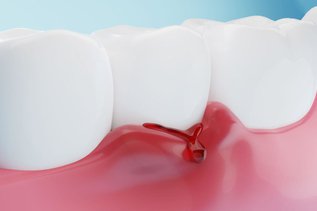
Bleeding gums when you brush are inflamed. That is what the bleeding means, and it is almost never a sign that you are brushing too hard. Healthy gum tissue doesn't bleed when a soft brush passes over it, just as healthy skin doesn't bleed when you wash it. In most cases, plaque along the gumline is the cause; the condition is early gingivitis, and it can be completely reversible within one to two weeks with proper cleaning. If the bleeding persists after two weeks of genuinely good home care, the problem has moved past what brushing can fix and needs to be addressed. The distinction between those two situations is what this article is about.
Key Takeaways
- Bleeding on brushing is a sign of inflammation, not of brushing too hard. Backing off the area makes it worse rather than better.
- It is extremely common and still not normal. In the most recent national measurements, 83% of Canadian adults bled during a gum examination, and the figure rose to 90% among adults aged 20 to 39.
- Early gingivitis is fully reversible. Periodontitis, where bone around the teeth has been lost, can be halted, but the lost bone does not come back.
- If you have just started flossing after a long gap, a few days of bleeding is expected and should settle within two weeks. Bleeding that persists beyond that is a different matter.
- Smokers bleed less, not more, because nicotine narrows the blood vessels in the gums. That makes the absence of bleeding an unreliable reassurance for anyone who smokes.
- Receding gums are the longer-term consequence of the same process, and unlike inflammation, recession does not reverse on its own.
Find our Dental Clinic Near You
Is Bleeding When You Brush Normal?
Common and normal are different, and gum bleeding is the clearest example in dentistry.
In late 2025, Statistics Canada released the first direct clinical measurements of Canadians' oral health in more than fifteen years, based on actual examinations rather than surveys. Among adults aged 20 to 79, 83% showed gum bleeding in at least one tooth during probing, with rates highest among people aged 20 to 39 at 90%. The average person examined had seven teeth that bled. So if your gums bleed, you are firmly in the majority, and that is precisely why nearly everybody assumes it is nothing.
The same data set gives the other half of the picture. Fifteen years ago, one in five Canadian adults had gum pockets measuring 4 mm or deeper, which is past the healthy range. In the new measurements, just over one in three does. Gum health in this country has gotten measurably worse over that period, not better, while tooth decay has stayed flat. Bleeding is the visible leading edge of that trend.
What makes bleeding worth paying attention to is that it is one of the few dental problems your body announces early and for free. Decay is silent until it reaches the nerve. Gum disease gives you a warning in the sink every morning, and it's easy to dismiss because nothing hurts.
What the Bleeding Actually Means
Between each tooth and the gum there is a shallow groove, roughly one to three millimetres deep in a healthy mouth. Plaque, a soft bacterial film, forms there continuously and has to be physically removed every day.
When you don't remove it, the bacteria release compounds your immune system reacts to. Blood vessels in the gum dilate and become more permeable, delivering immune cells to the area. The tissue lining that groove thins and becomes ulcerated. The result is gum that looks slightly red and puffy instead of pale pink and firm, sitting on a bed of dilated, fragile vessels just under a compromised surface. Light pressure from a brush or a strand of floss is enough to break them. That is the whole mechanism, and it explains why the bleeding is information rather than injury.
Where it goes next depends on how long it continues. Gingivitis is inflammation confined to the gum tissue itself, with no damage to the bone or the fibres attaching the tooth to it. Periodontitis happens when the inflammation persists and the body's response begins to break down the attachment and surrounding bone. The boundary between them is the most important thing to understand here, because one undoes itself and the other does not.
| Gingivitis | Periodontitis | |
|---|---|---|
| What you notice | Bleeding on brushing or flossing, slightly red or puffy gums | Bleeding, persistent bad breath, a bad taste, gums pulling away from the teeth |
| What is happening below the gum | Inflammation of the gum tissue only | Loss of the fibres and bone that hold the tooth in place |
| Pocket depth | Generally 3 mm or less | 4 mm and deeper, often with bleeding on probing |
| Is it reversible | Yes, completely | The disease can be halted; the lost bone does not regrow |
| What it takes | Consistent daily cleaning, usually with one professional cleaning | Deeper cleaning below the gumline, ongoing maintenance, sometimes surgery |
Why Your Gums Are Bleeding
Most bleeding traces back to the first item on this list. The rest matter because they change what you do about it.
Plaque Along the Gumline
This is the cause in most cases, and what trips people up is where it happens. Plenty of people brush conscientiously and still bleed because they clean the flat surfaces of the teeth, not the half-millimetre where the tooth meets the gum. That junction is exactly where plaque does its damage and exactly where a brush held flat against the tooth never reaches.
The other half of the problem is the space between teeth. A toothbrush cleans about three of the five surfaces of each tooth. Inflammation most often starts on the two surfaces facing the neighbouring teeth, which is why bleeding is often worse when flossing than when brushing.
You Have Just Started Flossing Again
This is the one situation where temporary bleeding is expected, not concerning. If the gums between your teeth have been inflamed for months and you suddenly begin cleaning there daily, they will bleed at first, and they may bleed more on day three than on day one as the tissue is disturbed.
That should settle. A reasonable expectation is noticeably less bleeding within a week and none by two weeks. The mistake almost everybody makes is stopping on day four because the bleeding seems to be getting worse, which is when it was about to start improving.
Technique and a Hard Toothbrush
A hard-bristled brush used with horizontal scrubbing can directly traumatize gum tissue, and it can cause bleeding and later lead to recession. But the fix isn't to brush less. Use a soft brush angled about 45 degrees into the gumline, with short, gentle movements, twice a day for two minutes. Pressure does not clean; contact and time do.
Hormones
Progesterone and estrogen both increase the gums' inflammatory response to the same amount of plaque, which is why gums can start bleeding during puberty, around the menstrual cycle, during pregnancy, and through menopause without anything changing in your routine.
Pregnancy is the most pronounced version, and it affects a large share of pregnant patients. Dental care during pregnancy is safe, and cleanings are actively recommended rather than postponed, since untreated gum inflammation has been associated with poorer pregnancy outcomes. If you are pregnant or planning to be , tell your dentist so they can adjust your schedule accordingly.
Medications
Two groups matter. Blood thinners such as warfarin, newer anticoagulants, and daily aspirin make bleeding more visible and last longer. They don't cause inflammation, so bleeding in someone taking them still means the gums are inflamed; it just looks more dramatic.
The second group causes gum tissue to overgrow, making it harder to clean and more prone to bleeding. Common culprits include certain calcium channel blockers used for blood pressure, some anti-seizure medications, and immunosuppressants. Never stop a prescribed medication over this. Mention it to your dentist, because management may change.
Smoking, and Why It Hides the Problem
This one runs opposite to intuition. Nicotine constricts blood vessels, reducing blood flow to the gums and suppressing visible signs of inflammation. A review of tobacco and periodontal disease in young adults put it directly: prolonged and heavy smoking can reduce gingival bleeding and therefore mask the clinical marker of bleeding on probing, with implications for potential misdiagnosis and failure to detect periodontitis at an early stage.
The practical consequence is that a smoker whose gums do not bleed may be given a clean bill of health. Underneath, young smokers show more bone loss and more attachment loss than non-smokers, while the warning sign that would normally prompt a visit has been switched off. If you smoke, the absence of bleeding is the least reliable indicator you have, and probing at a check-up matters more than it does for anyone else.
The Less Common Causes
Uncontrolled diabetes both worsens gum inflammation and is worsened by it, which is why persistent bleeding alongside increased thirst or fatigue is worth raising with a physician. Chronic dry mouth removes saliva's cleansing and antibacterial effect and leaves the gums more vulnerable. Severe vitamin C deficiency causes spongy, bleeding gums; it is rare in Canada but does still occur in people with very restricted diets.
Rarely, gums that bleed spontaneously rather than on contact, across the whole mouth, alongside easy bruising or bleeding elsewhere, can point to a problem with blood cells or clotting. That presentation is uncommon, but it belongs with a family doctor, not a dentist.
"I have been doing this for over thirty years, and the sentence I hear most often is that the gums only bleed a little, and only on one side. People grade it as minor because it is painless and because they assume everyone's gums do it. What I try to explain is that bleeding is the only free warning gum disease ever gives you. Nobody arrives with a loose tooth and no prior signal. The signal was there for years in the sink." Dr. Jerry Jesin, DDS, North York Smile Centre
What to Do About It: The Two-Week Test
There is a simple way to find out which situation you are in, and it takes fourteen days.
The method is to clean the gumline and between the teeth properly, every single day, without exception, and see what happens. Use a soft brush angled into the gumline for two minutes twice daily. Clean between every tooth once a day with floss, interdental brushes or a water flosser, whichever you will actually use. Do not skip the areas that bleed. Those areas need it most, and avoiding them lets the inflammation persist.
| When | What you should be doing | What to expect |
|---|---|---|
| Days 1 to 3 | Soft brush at the gumline twice daily; clean between all teeth once daily | Bleeding may increase. This is normal and is not a sign of damage |
| Days 4 to 7 | Exactly the same, without skipping the bleeding areas | Bleeding starts to reduce; gums begin to look less puffy |
| Days 8 to 14 | Same routine, now habitual | Bleeding should be minimal or gone; gums firmer and paler |
| After 14 days | Keep going regardless of the result | Still bleeding means tartar below the gumline or something else; book an appointment |
Getting the Technique Right
Most people who bleed are not lazy about brushing. They are cleaning the wrong half-millimetre. Hold a soft brush so the bristles meet the tooth at roughly 45 degrees, tipped into the junction where tooth meets gum, and use short back-and-forth or small circular movements rather than long horizontal strokes. Try to get bristle tips just under the gum margin, not to scrub the enamel, which doesn't need scrubbing.
Two minutes is longer than it feels. Most people brush for around 45 seconds and are confident it was two. Use a timer or an electric brush with one built in, and divide the mouth into four sections of thirty seconds so the back teeth on your non-dominant side get the same attention as the front ones you can see.
Pressure is the other half. Bristles that splay outward press too hard, and hard pressure with a hard brush is one of the most reliable ways to cause recession later. An electric brush with a pressure sensor solves this for people who cannot feel the difference, which is most of us.
Choosing Between Floss, Interdental Brushes and a Water Flosser
All three work. The one that works for you is the one you will do every night, and here the honest advice is to choose based on your own behaviour rather than what performs marginally better in a trial.
Floss removes adherent plaque from tight contacts most thoroughly and costs almost nothing, but it is fiddly, and most people quietly abandon it. Interdental brushes, the small bottle-brush style, are easier to handle and are more effective where the gaps are larger, which is common in adults with any degree of recession. A water flosser suits bridges, implants, braces and anyone with limited dexterity, and it wins on compliance because people actually use it.
Whatever you choose, the standard is to clean every gap once a day. Cleaning between the front teeth is easy, but skipping the back ones lets inflammation persist where you cannot see it.
Why Some Bleeding Does Not Respond
The test works because it separates the two possible causes. Plaque is soft, and you can remove it. Tartar is plaque that has hardened into a mineral deposit, usually below the gum margin where you cannot see it, and no amount of brushing will shift it. It also has a rough surface that collects more plaque, so it keeps the inflammation running no matter how careful you are.
That is what a professional dental cleaning does, and home care cannot: remove deposits from below the gumline with instruments, at which point the tissue can finally heal. For straightforward gingivitis, one cleaning plus a corrected home routine resolves it. For anything deeper, the cleaning is more involved and repeated over several appointments, sometimes with the mouth treated in sections under local anesthetic.
When Bleeding Gums Become Receding Gums
Recession is where this story ends if inflammation runs for years. As the attachment and bone are lost, the gum margin migrates down the tooth, exposing root surface that was never meant to be in the mouth.
The root is not covered in enamel. It is a softer material that decays considerably faster, wears more easily, and transmits hot and cold straight toward the nerve, which is why sensitivity to cold is often the first thing people notice rather than the appearance.
Inflammation isn't the only cause, which matters because many people with recession have never had bleeding gums. Aggressive brushing with a hard brush is a well-established contributor. So is a naturally thin gum biotype, which is inherited. Teeth that sit outside the arch have less bone covering them to begin with. Orthodontic movement, lip and tongue piercings, and clenching and grinding all contribute.
The answer to the question everyone asks is no. Gum tissue that has receded does not grow back on its own, and toothpaste or mouthwash cannot restore lost gum tissue. Cleveland Clinic notes that bone loss is common with gum recession, and untreated recession can increase the risk of further gum problems and tooth loss.
What can be done falls into two parts. The first is stopping the progression by removing whatever is causing it, which means treating the inflammation, correcting brushing technique and pressure, or addressing a grinding habit with a night guard. The second is managing what has already been exposed. A desensitizing agent or fluoride varnish applied at an appointment reduces sensitivity, a tooth-coloured filling rebuilds a worn notch at the gumline and protects the softer root surface from decay, and in suitable cases a gum graft surgically covers the exposed root using tissue taken from elsewhere in the mouth. Grafting isn't appropriate for every situation, and it is a decision made after identifying the cause, not before.
The practical point is that dentists measure and track recession. If a dentist tells you a tooth has receded two millimetres, the useful question is not whether it will grow back but whether it was two millimetres last year.
"Recession is the part patients can see, so it is usually what brings them in, but by then the interesting conversation has already been missed. The tissue does not recede for no reason. Either something is inflaming it, or something is abrading it, and those need completely different answers. Covering the root without finding out which one it was just means doing it again in five years." Dr. James C.H. Ko, DDS, North York Smile Centre
When to See a Dentist
Book an appointment if bleeding persists after two weeks of consistent, correct home care. That is the clearest single trigger, and it requires no interpretation on your part.
Book sooner if any of these are present: persistent bad breath or a bad taste that returns after brushing; gums that have visibly pulled away so a tooth looks longer than its neighbour; any tooth that feels loose or has shifted position; a change in how your teeth meet when you bite; pus or a swelling at the gumline; or gums that bleed on their own without anything touching them.
A dental examination settles this quickly. A graduated probe measures pocket depths around each tooth in a few minutes and shows exactly where you sit: whether this is gum inflammation that will resolve, or attachment loss that needs a treatment plan. X-rays show the bone level, which no gum exam alone can reveal.
Bleeding Is Information, Not an Inconvenience
What makes gum disease unusual is how loudly it announces itself and how easy it is to ignore. It does not hurt. It costs nothing to notice. And because most people around you have it too, it registers as ordinary rather than the earliest possible warning. Nine in ten Canadians in their twenties and thirties are bleeding on examination, and very few of them think anything is wrong.
Give it two weeks of proper cleaning, and you will have your answer, because gingivitis resolves and gum disease does not. If the bleeding stops, keep doing what fixed it. If it does not, that is worth an appointment rather than another year of assuming it is normal. Our team in North York can measure exactly where your gums stand and tell you plainly whether this needs a cleaning or a plan. Contact us to book, and mention the bleeding when you call.
Frequently Asked Questions
Is it normal for gums to bleed when brushing?
It is common but not normal. Healthy gums do not bleed under the light pressure of a soft toothbrush. Bleeding means the tissue is inflamed, almost always because plaque is sitting along the gumline. Recent national measurements found that 83% of Canadian adults bleed during a gum examination, which helps explain why so many people assume it is unremarkable.
Should I stop brushing an area that bleeds?
No, and this is the most common mistake people make. The bleeding is caused by inflammation from plaque that has not been removed, so leaving the area alone lets the inflammation continue. Clean it gently with a soft brush and keep cleaning between those teeth daily. The bleeding usually settles within one to two weeks.
Can bleeding gums heal on their own?
Gingivitis, the early stage, usually resolves fully within two weeks once you consistently remove plaque. It does not resolve without that change, since the cause is still present. If bleeding continues past two weeks of good home care, hardened tartar below the gumline is the likely cause, and only a professional cleaning can remove it.
How long does it take for bleeding gums to stop?
With correct daily cleaning, most people see a clear reduction within a week and little or no bleeding by two weeks. Expect bleeding to increase slightly in the first few days as inflamed tissue is disturbed; that is normal and not a reason to stop. No improvement after fourteen days means an appointment is needed.
Do receding gums grow back?
No. Receded gum tissue does not regenerate on its own, and no toothpaste, rinse, or oil reverses it. You can stop it from progressing by treating the cause and managing the exposed root with desensitizing treatment, fluoride, or a tooth-coloured filling. Surgical gum grafting can cover exposed root in suitable cases.
Can bleeding gums be a sign of something serious?
Usually they indicate gum inflammation and nothing more. Occasionally they point elsewhere: uncontrolled diabetes worsens gum disease, severe vitamin C deficiency causes bleeding gums, and rarely a clotting or blood cell disorder presents this way. Bleeding that happens spontaneously across the whole mouth, or comes with easy bruising, warrants a family doctor rather than a dentist.
Why do my gums bleed only when I floss?
Because gum inflammation usually starts on the surfaces between your teeth, and a toothbrush never reaches them. Bleeding when you floss but not when you brush is a normal pattern for early gingivitis between the teeth. Keep flossing those areas daily; that is what resolves it, and stopping is what allows it to continue.